The Hi-Res Audio Scam: What’s Actually on the Disc?
Somewhere on a shelf near you there’s probably a disc with a fancy sticker on it. “Advanced High Resolution.” “24-bit/96 kHz.” “DSD.” Maybe it’s an SACD, a DVD-Audio or a Blu-ray Audio disc, the premium formats record companies sell as the high-resolution, HD version of an album. You paid two or three times what the CD costs, because the sticker promised the album would sound better than it ever had.
More than one time in five, what you actually got was the CD.
Over the summer I built a detector into the app I make. It has now tested 1,225 of these discs in real people’s collections, and 272 of them failed. They hold CD-quality audio, no better than the $10 CD, stretched to fit a bigger disc and sold back at triple the price. That’s more than one in five. Go look at your shelf and count to five.
These aren’t obscure budget titles, either. The failures include some of the most famous albums ever made: Prince’s Purple Rain, Rush’s Moving Pictures, Dave Brubeck’s Time Out, and records by Miles Davis, The Police and Diana Krall.
How a CD Gets Dressed Up as HD
Picture an old DVD blown up and sold as a 4K Blu-ray. It fills the bigger screen, but no new detail appears, because the detail was never there. The industry calls this upsampling. For the buyer, it means paying HD prices for the CD.
Catching it is simpler than it sounds. Every recording has a ceiling, the highest sound it can hold. A CD’s ceiling sits just above the top of human hearing. The whole point of hi-res is a much higher ceiling, with room for more of the original recording.
On a real hi-res disc, that extra room always has something in it, even if it’s faint: the hiss of the studio tape, the air in the room, the hum of the equipment. It’s quiet, but it’s real, and it goes all the way up.
On a fake, the music runs into the CD’s ceiling and stops. Above it there’s nothing. Not quiet. Nothing. It’s a silence so perfect it can’t happen in the real world, only inside a computer. Nothing was ever recorded up there, because the file it came from couldn’t hold it.
| Format | Discs tested | Failed | Share |
|---|---|---|---|
| SACD | 971 | 234 | 24% |
| Blu-ray Audio | 210 | 25 | 12% |
| DVD-Audio | 44 | 13 | 30% |
| All discs | 1,225 | 272 | 22% |
Why Would I Tell You This?
I sell an app for these discs, so it’s fair to wonder why I’d write this. When I bought my copies, I wish someone had told me which ones to skip in favor of the CD. Nobody did, so I built the list I wanted and made it public, with names. This isn’t a sales pitch. I just find it fascinating that something this obviously a scam has slipped by for decades, in a world where a coffee cup has to warn you that coffee is hot.
The Hall of Shame
Start with Prince’s Purple Rain on Blu-ray. The stereo version is sold as “96 kHz 24-bit.” On all six tracks tested, the music stops dead barely above a CD’s ceiling, with that perfect computer silence above it. On this release, nothing exists up there. The Dolby Atmos surround mix on the same disc doesn’t claim to be hi-res, so it isn’t judged. It’s the stereo version, the one with the sticker, that fails.
The list keeps going. Rush, Moving Pictures. Talking Heads, Remain in Light. King Crimson, Larks’ Tongues in Aspic. The Doors, L.A. Woman. John Lennon, Mind Games. On SACD: Miles Davis, Seven Steps to Heaven. Dave Brubeck, Time Out. Oasis, (What’s the Story) Morning Glory? The Police, Ghost in the Machine. Diana Krall, Love Scenes. Keith Jarrett, The Köln Concert, a live recording from 1975 that somehow still came out of a CD-quality file.
Every one of them is on the page, with its measurements and the test that caught it. Don’t take my word for it, just scroll the page.
Is the Detector Fair?
Before anyone from an audiophile forum shows up in my inbox: yes, and then some. The detector gives every disc the benefit of the doubt. A disc never fails just for having a low ceiling. Plenty of honest transfers of 1970s tape have almost nothing up there, because the tape didn’t either, and those pass. What matters is whether there’s real sound above the ceiling. A disc fails when that space is dead empty, when someone filled it with fake hiss to hide the gap, or when it shows one of a couple of other telltale signs of a stretched file.
Every rule was tested against discs I already knew the answer for, real on one side and fake on the other. A disc with eight real hi-res tracks and two fakes still passes, because sometimes the original recording of a song is lost or unavailable. Getting all this right took a lot of discs and far more time than I expected, which, as my wife will tell you, is the normal byproduct of my tunnel vision.
Same Album, Opposite Answer
Two points of fairness.
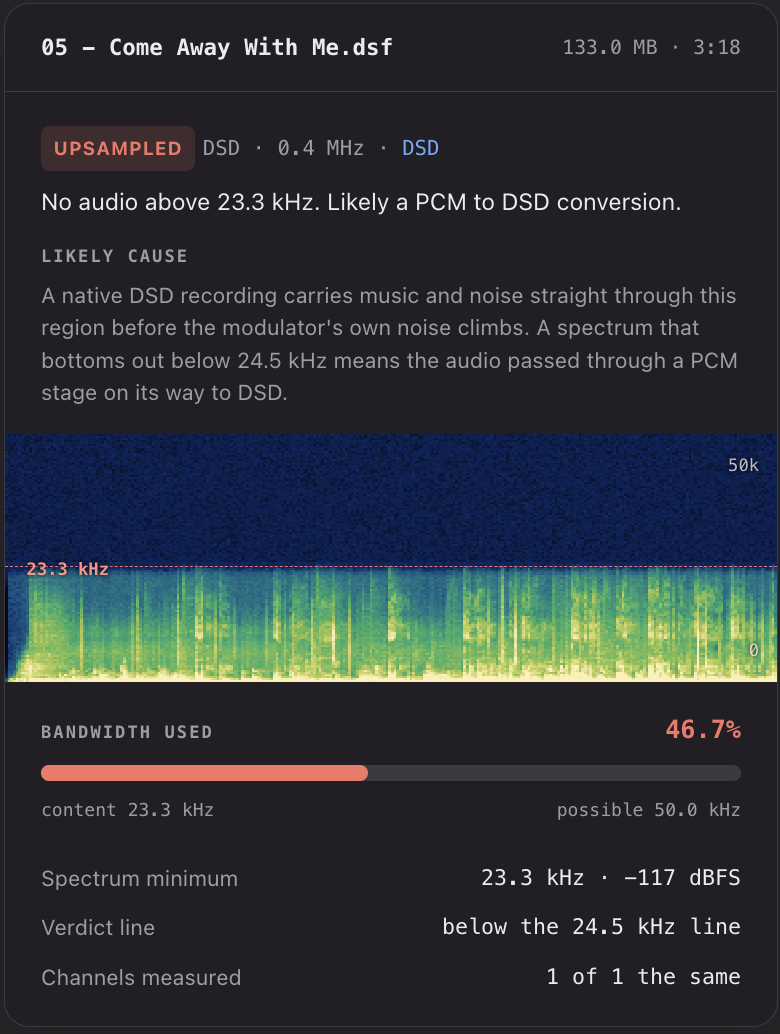
First, a result applies to the edition that was tested, not to every version of that album ever made. Norah Jones’ Come Away With Me is the textbook case, and yes, I recommended that SACD in my discs worth owning post in April. The 2003 SACD is a stretched CD. The 2012 SACD was made from the analog tapes, passes clean, and sounds really good. Same title, same label, opposite answer, and only the year on the spine tells you which one you’re holding. Mine is the 2012. If yours is the 2003, I’m sorry, and also I’m not the one who pressed it.
Second, some albums were recorded digitally in the first place. Dire Straits’ Brothers in Arms was recorded in 1985 on an early digital machine whose ceiling sat barely above a CD’s. My father played that album on every lake trip we ever took, and there was never anything above that ceiling in it. So the hi-res version on DVD-Audio can’t hold more than the CD did. The disc is honest about its history. The sticker is not.
How Does This Keep Happening?
Mostly convenience. A label licenses an old album for a fancy reissue and asks the archive for the master, the studio’s best copy of the recording. What comes back is whatever copy is on hand, and for a lot of older albums that’s a file made back in the CD era. Nobody checks it, because checking isn’t anybody’s job. It goes into the software that builds the disc, which accepts it without complaint, and the HD sticker gets printed because of the kind of disc it is rather than what’s on it. The buyer had no way to check, so nobody ever did. Whether that’s laziness or something worse, you paid the bill. The checking part is what I want to change.
Your Ears Aren’t the Problem. Your Wallet Is.
This is where forum reactions usually get it exactly backwards. A fake hi-res disc doesn’t sound worse than the CD. It sounds exactly like the CD, because it is the CD. If you loved it last week, you’ll love it next week, and no measurement changes that.
The problem is false advertising and money. An audiophile SACD reissue typically lists at $30 or more. The CD of the same album is about $10. That extra $20 or so buys one thing, the higher-resolution version, and on more than one disc in five it isn’t there. Plenty of these buyers also own a player that cost anywhere from $500 to several thousand dollars, built for one job: playing that extra resolution. On these discs it does that job very faithfully, on nothing. You paid for something you didn’t get, and that’s worth being annoyed about.
Does Hi-Res Even Matter?
If the fakes sound the same as the CD, you might wonder whether real hi-res sounds any better in the first place. I wrote about this in the snake oil post, and my answer hasn’t changed. In blind tests, where listeners don’t know which version is playing, most people can’t tell the difference, trained listeners included. I’m not going to argue the feeling in my tum tum against the studies.
But that cuts the other way. If a label charges extra for a difference that’s hard to hear, the least it can do is actually deliver it. “You can’t hear it anyway” is a weak excuse for selling someone something that isn’t there. What actually makes a disc worth buying is the mastering, the final polish an engineer gives the sound before release. A carefully mastered CD beats a badly mastered hi-res file every time, and some of the flagged discs are still the best-sounding version of the album you can buy. They just aren’t hi-res, and they shouldn’t be priced like they are.
Check Your Own in Ten Seconds
Drop a music file on losslessextract.com/verify-hires (FLAC, WAV, MKA, M4A or DSF). No music gets uploaded and nothing gets stored, because the whole test runs inside your browser using the same math as the app. I know every website says that. This one means it, and the tech-minded can watch the browser’s network tab if they’d like to be that person. About ten seconds later you get a verdict, the reason for it, and a picture of the sound so you can see the cliff with your own eyes. A Save Card button lets you send the result to the store, the label, or the forum thread that told you the disc was worth it.
For whole discs, Lossless Extract tests them while it copies the music off and flags anything that’s a stretched CD. If you let it, it adds the result to the public list, so the next person can check an edition before they buy instead of after. That’s where the 1,225 discs came from, and the list grows with every scan. Some of you are about to grow it quite a bit.
The Bottom Line
I tested 1,225 premium discs from real collections, and more than one in five turned out to be the CD in an HD box, including some of the most famous albums ever made. The music is fine. The disc is the CD, and the CD was always fine. What’s not fine is paying triple for a sticker. The list is public, so check it before your next order. I’m checking mine too, and I’m not expecting to enjoy it.
Check a file you already own at losslessextract.com/verify-hires, or scroll the full list of tested discs on the same page.
If you want the detail on how the detector works, read How to Check If a Hi-Res File Is Actually Hi-Res.